

When it comes to digital marketing, one question almost every business owner asks is: “How much should I actually spend on marketing?”
A ₹20,000 monthly marketing budget and a ₹50,000 monthly budget can produce very different outcomes—but spending more money does not automatically guarantee better results. The real difference comes from where the budget goes, how strategically it is used, how quickly campaigns can be tested, and how much room there is for optimization and scaling.
The right question is not simply “Which budget is better?” but rather “What can my business realistically achieve with each budget?”
What Does a ₹20,000 Digital Marketing Budget Actually Cover?
A ₹20,000 monthly digital marketing budget can be a practical starting point for small businesses, startups, local businesses, and businesses entering digital marketing for the first time.
At this level, the focus should not be on trying to do everything simultaneously. A limited budget works better when it is concentrated on the channels most likely to generate results. For example, a business may prioritize Google Business Profile optimization, local SEO, social media, content creation, or a focused Google/Meta Ads campaign, depending on its goals.
A ₹20,000 budget may typically focus on:
- 1–2 primary marketing channels
- Basic SEO and local visibility
- Google Business Profile optimization
- Limited paid advertising
What Changes When the Budget Increases to ₹50,000?
Moving from ₹20,000 to ₹50,000 does not simply mean spending an additional ₹30,000. It creates significantly more marketing flexibility.
A larger budget allows a business to work on multiple parts of the customer journey at the same time. Instead of choosing between visibility and lead generation, businesses can potentially work on both. They can also test different audiences, creatives, offers, keywords and campaigns while continuing the activities that are already producing results.
For example, a business spending ₹50,000 could potentially combine SEO + Google Ads + Meta Ads + content + social media + conversion optimization rather than relying on only one or two activities.
₹20,000 vs ₹50,000
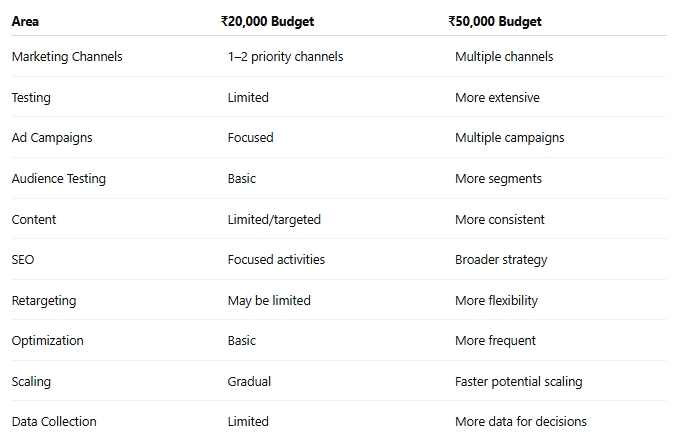
The important point is that ₹50,000 does not guarantee 2.5× more leads than ₹20,000. Digital marketing does not work like a simple multiplication formula.
Is ₹50,000 Always Better Than ₹20,000?
This is where many businesses misunderstand digital marketing. A larger budget cannot fix a weak marketing strategy. If the targeting is wrong, the offer is unclear, the website does not convert, or the sales process is slow, increasing the advertising budget may simply increase the number of people reaching a poor conversion experience.
Imagine a business spends ₹20,000 and generates 20 leads, but only one becomes a customer because the landing page is confusing and enquiries are not followed up properly.
Increasing the budget to ₹50,000 may generate more traffic and more enquiries—but if the underlying problems remain, the business could simply spend more money without achieving proportional growth.
Where Should Your Business Spend ₹20K or ₹50K?
There is no universal digital marketing budget that works for every business. The ideal allocation depends on the industry, location, competition, customer value, sales cycle and business objective.
Consider focusing on:
Increasing the budget to ₹50,000 may generate more traffic and more enquiries—but if the underlying problems remain, the business could simply spend more money without achieving proportional growth.
- One primary lead-generation channel
- Local SEO / Google Business Profile
- Essential social media activity
- Focused content creation
- One carefully targeted paid campaign
Conclusion: Your Marketing Budget Should Follow Your Growth—Not Your Ego
₹20,000 and ₹50,000 are not simply two different spending levels. They represent two different levels of testing, flexibility, reach and scalability.
It is how intelligently that budget is used.
If your marketing strategy is generating results, the next step may be to invest more. If your campaigns are not converting, increasing the budget may not be the answer—fixing the strategy may be.
Talk to Apex Digital and build a marketing plan based on your goals, audience, competition and budget—not a one-size-fits-all package.
Frequently Asked Questions
1. Is ₹20,000 enough for digital marketing?
Yes, ₹20,000 can be a reasonable starting budget for many small businesses. The key is to focus on a limited number of high-priority channels rather than trying to do everything at once.
2. Will ₹50,000 generate 2.5× more leads than ₹20,000?
Not necessarily. Marketing results do not increase proportionally with spending. Targeting, offer, creative quality, website conversion and sales follow-up can have a major impact on the final result.
3. Should a new business start with ₹20,000 or ₹50,000?
For many new businesses, starting with a focused budget can help identify what works before scaling. However, businesses in highly competitive markets may need a larger budget to gather sufficient data and achieve meaningful visibility.
4. Should I spend more on SEO or paid advertising?
It depends on your business goals. Paid advertising can provide faster traffic and lead-generation opportunities, while SEO is generally a longer-term strategy for building organic visibility. In many cases, a combination of both can be effective.
5. How do I decide the right digital marketing budget for my business?
Start with your business goal, customer acquisition cost, average customer value, competition and current conversion rate. Your budget should be large enough to generate meaningful data and opportunities while remaining financially sustainable.