1. The Customer Journey Has Changed: Search Is No Longer Just Google
For years, the customer journey for a local business was fairly predictable. Someone had a problem, opened Google, searched for a service, compared a few websites, checked reviews, and contacted a business.
That journey is now changing.
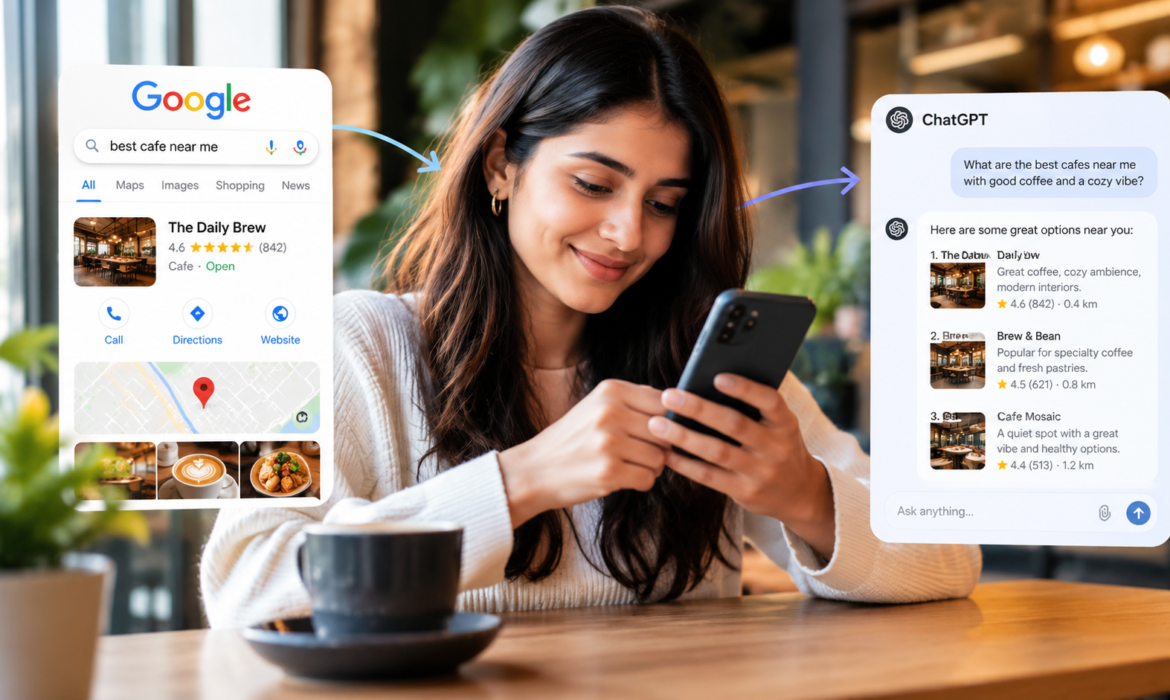
Customers are increasingly using AI-powered tools such as ChatGPT to research products, services, businesses, solutions, and even local recommendations. Instead of browsing ten different websites, a potential customer can ask an AI tool a detailed question and receive a summarized answer within seconds.
For example, someone looking for a digital marketing agency may previously have searched:
“Digital marketing agency near me”
Now, they may ask:
“Which digital marketing agencies in Pune are good for a small business with a limited budget?”
The new customer journey can look like:
Google Search → Website → Reviews → Social Media → AI Research → Shortlist → Enquiry → Conversion
Or sometimes:
ChatGPT → Business Research → Google/Maps Verification → Reviews → Website → Enquiry
The important point is that Google and AI are not necessarily competing channels for businesses. They can become different stages of the same customer journey.
2. Google Still Matters — But Your Website Needs to Do More
Google remains an important discovery platform for local businesses.
When someone searches for a service, your business may appear through organic results, Google Maps, local listings, advertisements, featured results, or other search features.
But ranking on Google is only the beginning.
A visitor who reaches your website still needs a reason to trust your business.
Your website should answer questions such as:
What exactly does your business offer?
Who do you help?
Where do you provide your services?
Why should customers choose you?
What makes you different from competitors?
What results or experience can you demonstrate?
3. ChatGPT Changes How Customers Discover and Evaluate Businesses
AI has introduced a different way of searching.
Instead of entering short keywords, users can describe their situation in natural language.
For example:
“I own a small manufacturing company in Pune. I want to generate B2B leads through digital marketing. Which strategies should I consider?”
This is much more detailed than a traditional search query.
The customer expects the AI to understand the context and help them make a decision.
This creates a new opportunity for businesses: becoming a credible source of information that AI systems can understand and potentially reference when generating answers.
4. The New Local Marketing Strategy: Be Discoverable Everywhere
The biggest mistake a local business can make is treating Google, social media, websites, reviews and AI as completely separate activities.
They discover your website.
Step 2 — Research
They read your service pages and blogs.
Step 3 — Validation
They check your Google reviews, social media presence and online reputation.
Step 4 — AI Research
They may ask an AI assistant questions about agencies, pricing, strategies or what they should look for.
Step 5 — Comparison
They compare several businesses.
Step 6 — Conversion
They return to your website or Google Business Profile and contact the company.
Conclusion: Don't Just Try to Rank — Become the Business Customers Choose
The transition from traditional Google searches to AI-assisted discovery doesn’t mean Google SEO is dead.
It means the customer journey is becoming more conversational, more research-driven, and more fragmented across multiple digital platforms.
1. Is Google SEO still important now that people are using ChatGPT?
Yes. Google continues to be an important source of discovery for local businesses. AI tools add another way for customers to research and evaluate information. Businesses should focus on strong SEO while also creating useful, authoritative content that answers real customer questions.
2. Can ChatGPT recommend my local business?
AI platforms can generate recommendations based on the information and capabilities available to them, but businesses should not assume that simply publishing a blog guarantees a recommendation or citation. Building a strong, trustworthy and consistent online presence is a better long-term approach.
3. How can a local business become more visible in AI search?
Start by creating genuinely useful content that answers customer questions in depth. Maintain accurate business information, develop topical authority, strengthen your website and local SEO, earn legitimate reviews, and establish a consistent presence across relevant online platforms.
4. Should businesses stop focusing on keywords?
No. Keywords still help search engines understand what a page is about. However, modern SEO should go beyond keyword repetition. Businesses should focus on search intent, topic coverage, useful information, natural language and the overall quality of the user experience.
5. What is the biggest SEO mistake local businesses make?
One common mistake is focusing entirely on rankings and traffic instead of the complete customer journey. Getting visitors is only one part of digital marketing. Your website, content, reviews, reputation and calls to action all influence whether that visitor eventually becomes a customer.